
45
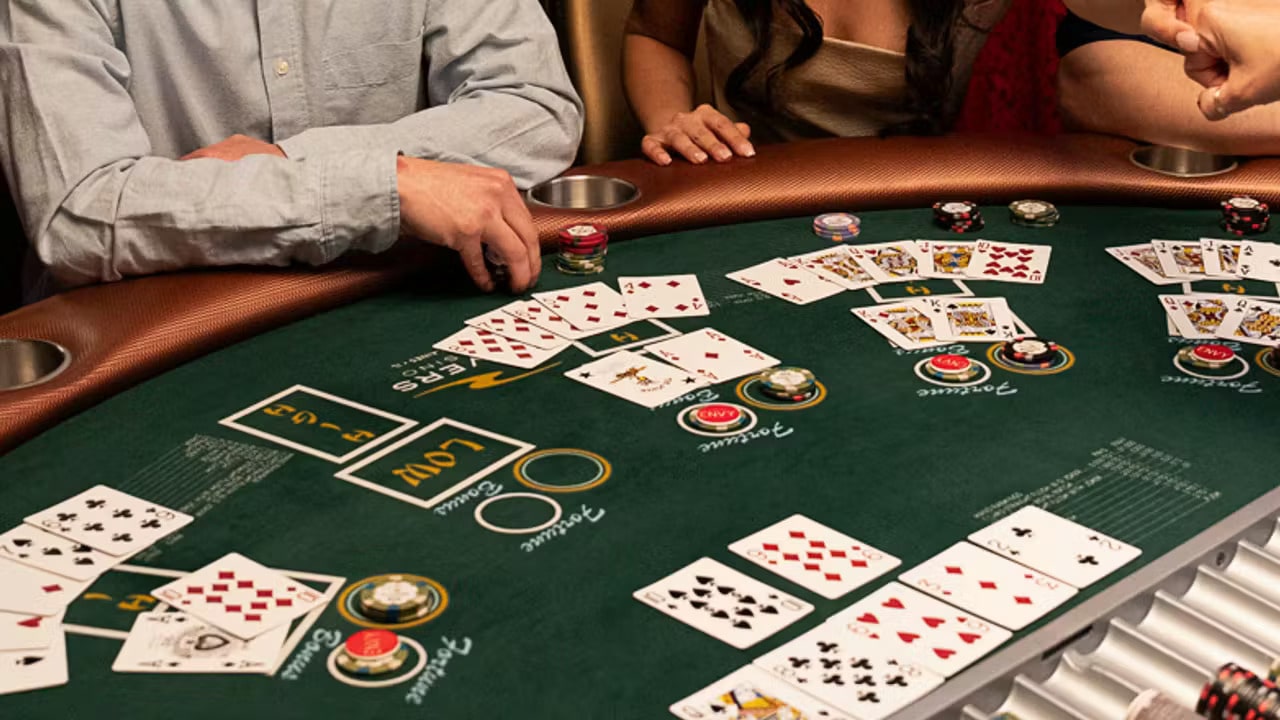
Wander past the raucous craps pits and the rapid-fire action of the blackjack tables in any major American casino, and you will eventually stumble across an island of relative tranquility. Players sit comfortably with tall stacks of chips that rarely seem to shrink or grow in dramatic bursts. Conversations flow freely across the felt, drinks linger on cup rails, and hands unfold at a measured, contemplative pace.
This is the Pai Gow Poker pit. To the untrained eye, it appears to be just another poker derivative cooked up by gaming corporations to capture floor space. In reality, Pai Gow Poker is one of the most successful cross-cultural adaptations in the history of gambling. It represents a brilliant marriage between an ancient Chinese game of dominoes and the five-card hand rankings that define Western card rooms.
Understanding how this hybrid game works, where it came from, and why its mechanics produce such a unique rhythm reveals why it has maintained a permanent place on casino floors for decades.
The Cultural Lineage: From Ancient Tiles to Playing Cards
To understand the soul of Pai Gow Poker, you have to look past the standard deck of bicycle cards and travel back to the Song Dynasty. The original game of Pai Gow, which loosely translates to “make nine” or “card nine,” is played not with cards, but with a set of thirty-two Chinese domino tiles.
In traditional Pai Gow, each player receives four bone-and-bamboo tiles. The objective is to arrange those four tiles into two distinct hands of two tiles each: a front hand and a rear hand. To win, a player’s front hand must beat the banker’s front hand, and the rear hand must beat the banker’s rear hand.
The traditional tile game is steeped in Chinese cosmology, featuring intricate tile pairings classified into civil and military suits. Memorizing the hierarchy of tile combinations requires months of study, making it notoriously intimidating for uninitiated Western players. For generations, traditional Pai Gow remained largely confined to Asian gaming salons and private clubs.
Everything changed in 1985 in Southern California. Sam Torosian, the owner of the Bell Card Club in Bell, California, was searching for a fresh game to draw patrons to his tables. Recognizing the popularity of traditional Pai Gow among local Asian-American gamblers, but knowing the steep learning curve of domino rankings kept casual American players away, Torosian engineered an inspired compromise.
He replaced the thirty-two domino tiles with a standard fifty-two-card deck plus a single joker, expanded the hand size from four tiles to seven cards, and substituted the complex Chinese tile values with traditional American poker hand hierarchies. The result was an instant sensation that spread rapidly from California card rooms to the Las Vegas Strip, Atlantic City, and international casinos worldwide.
How the Hybrid Mechanics Work
Pai Gow Poker preserves the foundational architectural concept of its domino ancestor: the art of the split.
Every round begins with seven cards dealt to each player and the dealer. Your task is to take those seven cards and divide them into two separate hands:
-
A five-card hand, traditionally called the back hand or high hand.
-
A two-card hand, known as the front hand or low hand.
The single golden rule of hand construction dictates that your five-card hand must always outrank your two-card hand. If you set your cards incorrectly—for example, placing a pair of Kings in your two-card hand while leaving only Ace-high in your five-card hand—you have committed a “foul.” A fouled hand is automatically surrendered and loses immediately.
Once all players set their hands, the dealer reveals the house hand and arranges it according to a strict, predetermined protocol known as the House Way. The showdown begins by comparing each player’s two hands against the corresponding hands of the dealer:
-
If both of your hands beat both of the dealer’s hands, you win your bet.
-
If both of your hands lose to the dealer’s hands, you lose your bet.
-
If you win one hand but lose the other, the round is declared a push, and your wager is returned untouched.
The Role of the Semi-Wild Joker
One of the most distinctive features of Pai Gow Poker is the fifty-third card in the deck. In standard poker variants, a joker is either completely wild or excluded entirely. In Pai Gow Poker, the joker operates as a restricted wild card, often referred to by old-school cardroom staff as “the bug.”
The joker cannot simply morph into any card you desire. It can only be used in two specific ways:
-
To complete a straight, a flush, a straight flush, or a royal flush in the five-card hand.
-
As an Ace in any other situation.
If you hold a King, Queen, Jack, and Ten alongside the joker, it functions as an Ace or a Nine to give you a straight. If you hold a pair of sevens and the joker, the joker does not give you three sevens; it gives you a pair of sevens and an Ace kicker. In the two-card hand, where straights and flushes do not exist, the joker always acts as an Ace.
The Mathematics of the Push and Bankroll Longevity
If you sit down at a high-stakes blackjack or baccarat table with a modest bankroll, a bad run of cards can clean you out in fifteen minutes. Pai Gow Poker behaves entirely differently. It is fundamentally a game of defensive balance.
Because you are dividing seven cards across two hands, the most common statistical outcome by far is a split decision. You win the high hand, the dealer wins the low hand, or vice versa.
In a standard session, approximately 41% of all hands result in a push. Another 29% result in player losses, and roughly 30% result in player wins. When nearly half of your hands result in a tie where no money changes hands, the volatility of the game drops through the floor.
This statistical reality gives Pai Gow Poker the lowest variance of almost any table game in the casino. It is the premier choice for players who want to stretch their gambling budget across several hours, enjoy free beverage service, and socialize without enduring the stomach-churning financial swings of faster games.
Where the Casino Finds Its Edge
Casinos do not offer games out of charity. If four out of ten hands push and players win nearly as often as they lose, how does the house turn a profit?
The casino’s mathematical edge comes from two core rules: copies and commissions.
A “copy” occurs when a player’s hand and the dealer’s hand have the exact same rank. For instance, if both you and the dealer hold an Ace-King in the two-card hand, the dealer wins the tie. The player never wins a copy. This slight asymmetric rule provides the dealer with an inherent mechanical advantage on every showdown.
Traditionally, casinos balanced the remaining payouts by charging a 5% commission on all winning hands. If you wagered twenty dollars and won both hands, the house paid you nineteen dollars, collecting one dollar as a house rake.
In recent years, many properties have moved toward commission-free versions, most notably Face Up Pai Gow Poker. In these games, the dealer plays their hand face-up so you see it before setting your own cards, and the 5% commission is eliminated entirely. To reclaim their mathematical edge, the casino introduces a specific contingency rule: if the dealer’s five-card hand ends up with an Ace-high total, all active player wagers automatically push, regardless of how strong the player’s cards are.
Setting Hands: Strategy Between the High and Low
The strategic brilliance of Pai Gow Poker lies in finding equilibrium. A novice player will often look at seven cards, spot a monster five-card hand, and dump everything into the back, leaving their two-card front completely defenseless.
If you hold a Full House consisting of three Jacks and a pair of Tens, your instinct might be to keep the entire Full House in your five-card hand. Doing so leaves you with two disconnected rags in your front hand—perhaps a four and a two.
A seasoned player understands that an unprotected front hand almost guarantees a push at best. In Pai Gow Poker, dividing that hand—placing three Jacks in the back and the pair of Tens in the front—creates two formidable holdings that give you a legitimate chance to sweep both hands and take down the bet.
The House Way
Every casino trains its dealers to set hands according to an exhaustive set of procedural guidelines called the House Way. These rules are mathematically optimized to minimize losses and maximize push rates.
The House Way dictates precise actions for every possible distribution:
-
No Pair: Place the highest card in the five-card hand, and the second- and third-highest cards in the two-card front.
-
One Pair: Keep the pair in the five-card hand, placing your two highest remaining single cards in the front hand.
-
Two Pair: Split the pairs between the two hands unless the pairs are very low (such as pairs of sixes and below with an Ace kicker), in which case you keep them together in the back to maintain a decent high hand.
-
Three of a Kind: Always keep the three of a kind together in the back hand, unless they are three Aces, where you split one Ace into the front hand.
-
Full House: Almost always split into three of a kind in the back and the pair in the front, unless you hold a secondary pair that can cover the front hand on its own.
One of the most welcoming aspects of Pai Gow Poker is that you do not need to memorize these complex flowcharts to play well. If you are ever unsure how to split your seven cards, you can simply set them face-down on the table and ask the dealer, “How would the house set this?”
The dealer is required by rule to turn your cards over and arrange them according to the strict House Way formula. Because the dealer does not have a personal financial stake in the outcome, they will gladly ensure your hand is set to the optimal standard without judgment.
The Communal Chemistry of the Table
Beyond the mathematics and the historical heritage, the true appeal of Pai Gow Poker is its social dynamic.
At a blackjack table, an inexperienced player who hits a twelve against a dealer’s six will often draw furious glares from tablemates who believe their cards were compromised. At a poker table, you are actively hunting the chips of the person sitting across from you.
Pai Gow Poker eliminates that friction entirely. Every player at the table is competing against the exact same house hand. Because everyone shares a common opponent and pushes occur with incredible regularity, the atmosphere is intensely collaborative.
Players routinely show their cards to one another, debate the merits of splitting pairs, and cheer when the dealer turns over a weak, disjointed holding. If the dealer opens a hand with no pair and an unimpressive Queen-high, the entire table celebrates simultaneously, knowing that almost every seat is about to get paid.
An Enduring Lesson in Balance
Pai Gow Poker survived the transition from private California cardrooms to international gaming hubs because it solved a fundamental design problem. It took the cerebral, patient balancing act of ancient Chinese dominoes and translated it into a visual language that every American poker enthusiast already understood.
It does not offer the dizzying highs of a roulette spin or the rapid-fire aggression of tournament Texas Hold’em. Instead, it offers balance, engagement, and extended play. When you sit down at a Pai Gow table, you are participating in a four-decade-old cultural synthesis that proves that in gambling, as in life, learning how to protect your front while strengthening your back is the true secret to staying in the game.
